
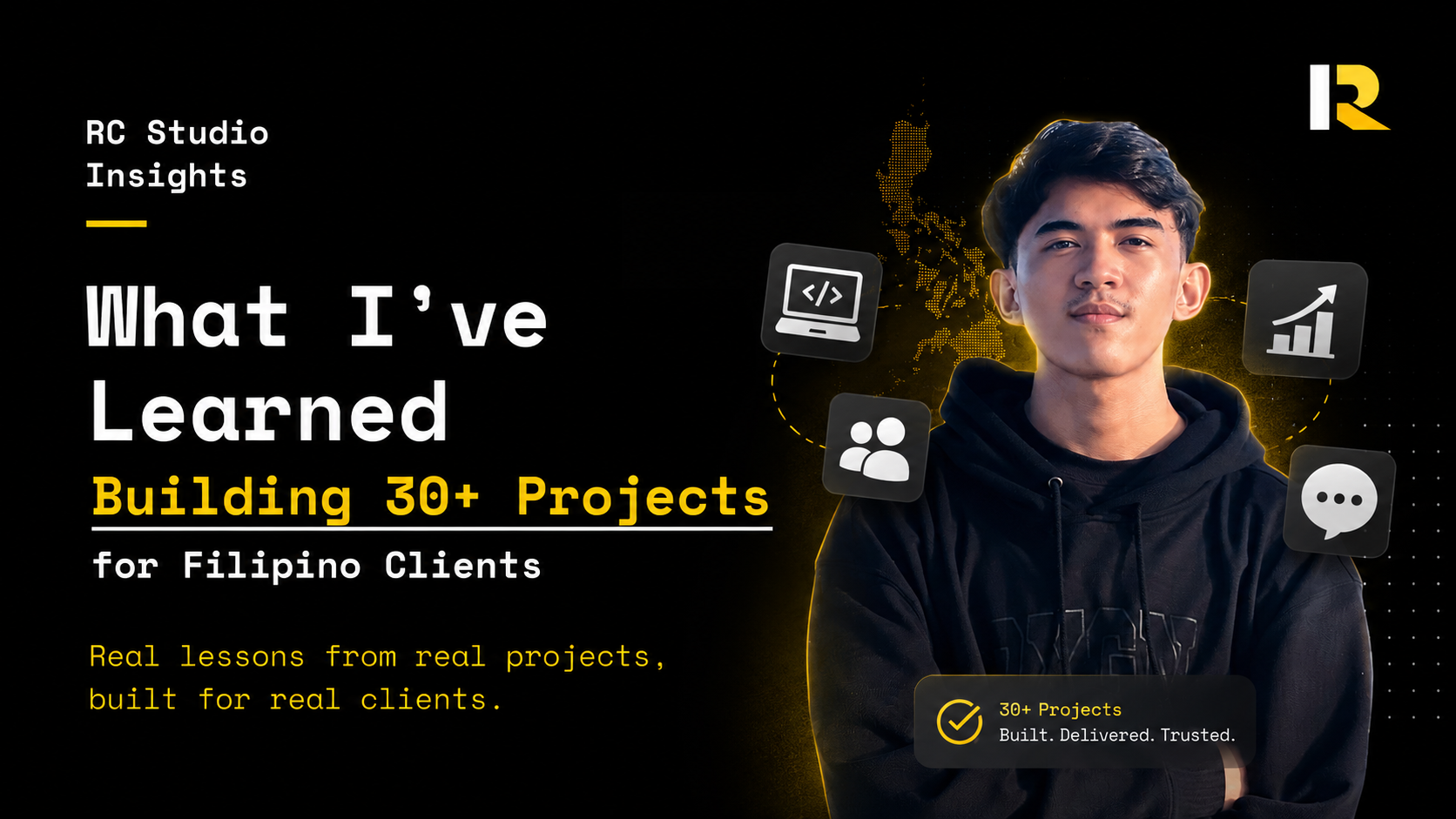
I’ve been building software and designing digital products for clients across the Philippines for years now — startups, small businesses, local government projects, NGOs, you name it. Over 30 projects in, I’ve seen patterns repeat themselves so many times that I figured it was worth writing them down.
Not to call anyone out. But because most studios won’t say these things out loud, and I think it actually helps clients make better decisions — and helps developers do better work.
So here goes.
1. The cheapest option almost always costs the most in the long run
I get it. Budget is tight. And there are a lot of freelancers and agencies offering rock-bottom rates. What most clients don’t realize until it’s too late is that low price usually means one of three things: the developer is learning on your project, corners are being cut on code quality, or there’s no real plan after launch.
I’ve inherited broken codebases from “affordable” developers more times than I can count. Rebuilding something is always more expensive than building it right the first time.
What to ask instead: “What does your process look like after the site/app goes live?” If they don’t have a clear answer, that’s a red flag.
2. Most clients don’t actually need what they think they need
A client once came to me asking for a full mobile app. After one discovery call, it turned out what they really needed was a well-structured booking form and an automated email system. We built that in two weeks for a fraction of the cost. It solved their actual problem.
This isn’t about upselling or downselling — it’s about listening. The best thing a studio can do is push back (respectfully) on the initial brief and ask why before jumping into what.
The lesson: A good software partner should be trying to understand your business, not just take your feature list at face value.
3. Design and development need to talk to each other from day one
One of the biggest project killers I’ve seen is when a client gets a design from one person and hands it to a separate developer to build. Sounds logical. In practice, it’s a disaster waiting to happen.
Designs that look great in Figma don’t always translate cleanly into code — especially on mobile, especially with real data, and especially when edge cases show up. When design and dev aren’t in sync from the start, you end up with a product that neither looks like the mockup nor works the way it should.
Why this matters for you: When you hire a studio or freelancer, ask how design and development are coordinated. If there’s no clear answer, expect rework.
4. Revision rounds without a defined scope will drain everyone
This one stings because it goes both ways. Clients want to keep refining until it feels right — totally understandable. But “unlimited revisions” is a myth that breeds scope creep, delayed launches, and burned-out developers.
The projects that go smoothest are the ones where both sides agree upfront on what “done” looks like. Not in a rigid, inflexible way — but with a clear shared definition of the deliverable.
What good looks like: A scoped contract with clear revision rounds, and an honest conversation when something falls outside that scope. No surprises.
5. Filipino businesses are leaving serious money on the table by underinvesting in their digital presence
This one is the big one.
The Philippine IT services market hit $5.7 billion in 2025 and is projected to more than double by 2034. The IT-BPM sector is on track for $42 billion in exports. Global companies are choosing the Philippines not just for outsourcing — they’re building full capability centers here.
And yet a huge chunk of local SMEs still have websites that look like they were built in 2014, no mobile optimization, zero SEO, and a Facebook page doing the heavy lifting.
The opportunity gap is massive. The businesses that invest in a real digital foundation right now — a fast, well-designed website, proper branding, maybe a lightweight internal tool to streamline operations — are going to be significantly ahead of competitors who wait.
You don’t need to spend millions. You need the right partner who can scope something smart, build it properly, and actually explain what they’re doing along the way.
What I try to do differently at Raldin Casidar Studio
I’m not going to pretend every project I’ve worked on was perfect. There were scopes that grew. There were timelines that slipped. There were features I’d redesign if I could go back.
But what I’ve committed to — and what I think makes the biggest difference — is being straight with clients from the very first call. If something will cost more than expected, I say it early. If an idea won’t work the way you think it will, I’ll tell you and suggest something better.
Good software work is mostly communication. The code is almost the easy part.
If any of this resonates — whether you’re a business owner thinking about your first website, or a startup that needs a real technical partner — feel free to reach out.
And if you’re a fellow developer reading this: the bar for honest, well-communicated project delivery in the PH market is still surprisingly low. That’s actually a big opportunity for those of us willing to do it right.
Raldin Casidar is a full-stack developer, UI/UX designer, and tech lead based in Mindanao, Philippines. He runs Raldin Casidar Studio, a software studio focused on building clean, functional digital products for clients across the Philippines and beyond.
📩 Open to project inquiries and collaborations — let’s talk.